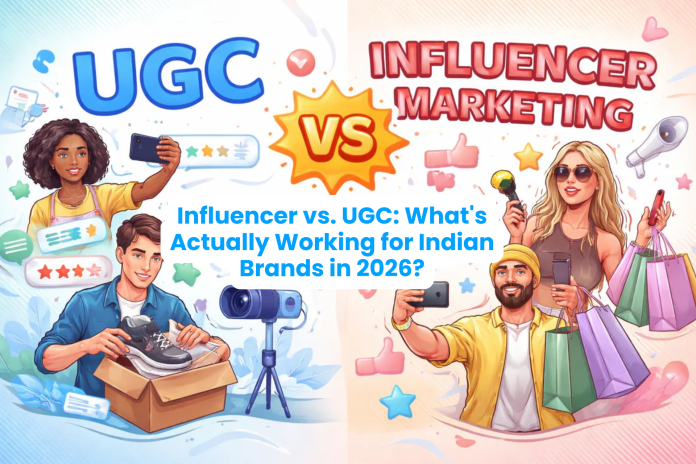
You’ve seen both. A Bollywood celebrity holding up a skincare product with a flawless caption and a 22-year-old from Pune filming herself in her bathroom saying, “Okay, this actually worked.” Both are trying to sell you the same moisturiser. But which one made you reach for your phone to buy it?
That question is at the heart of one of the biggest debates in Indian digital marketing right now: Influencer marketing vs. User Generated Content (UGC). And in 2026, the answer is more nuanced and more data-backed than ever before.
The Numbers Don’t Lie
India’s creator economy is booming. According to an EY report, India’s influencer marketing industry is projected to reach ₹3,375 crore by 2026, growing at a CAGR of 18%. With over 360 million Instagram users in the country, India is now one of the largest influencer markets in the world. Brands are clearly spending, but are they spending smart?
On the other side, the global UGC platform market was valued at $7.1 billion in 2025 and is projected to hit $8.48 billion in 2026, growing at a staggering 28.8% CAGR through 2034 (Fortune Business Insights). And the reason is simple: UGC converts. Product pages featuring customer content convert 74% higher than those without it, and brands using UGC see up to 29% higher conversion rates overall.
What Influencer Marketing Actually Does
Influencer marketing is, at its core, an awareness engine. When a brand partners with a creator, whether a mega-influencer with 5 million followers or a micro-creator with 80,000, it’s buying access to an engaged community and cultural credibility.
This is where influencers genuinely shine in India. Mamaearth is a textbook example. The D2C brand built its early identity through heavy investments in Instagram and YouTube creator partnerships, letting influencers demonstrate products in a natural, relatable way. When Gen Z consumers saw creators they trusted using Mamaearth face wash or hair oil, it drove real purchase intent and put products on family shopping lists. Today, Mamaearth is a publicly listed company worth thousands of crores.
For product launches, festival campaigns, or entering a new market, influencer marketing creates buzz fast. Over two-thirds of Indian consumers now rely on influencers for product discovery and purchase decisions. This is a shift that brands simply cannot ignore.
What UGC Actually Does
UGC is a different beast entirely. A UGC creator is paid to produce content, not distribute it. They could have zero followers. What they do have is the ability to film, edit, and deliver authentic-feeling video or photo assets that a brand then runs as paid ads, posts on social feeds, or uses on landing pages.
The numbers behind UGC’s trust factor are staggering. 92% of consumers trust peer recommendations over brand messages, and 84% say they trust a brand more when it features real user content in its marketing. In a country like India, where word-of-mouth has always driven buying decisions, like from your neighbour recommending a maid to your cousin vouching for a mechanic, UGC taps into something deeply cultural.
The cost argument is compelling, too. UGC creators are significantly cheaper than influencers because you’re paying only for the content, not their audience. For a startup or a D2C brand managing lean budgets, briefing 3–5 UGC creators monthly can generate a continuous pipeline of ad-ready content at a fraction of what one macro-influencer post costs.
The Real Question: Which Funnel Stage Are You At?
Here’s where most Indian brands go wrong: they treat this as an either/or choice. It isn’t. Influencer marketing fills the top of the funnel; UGC activates the middle and bottom.
Think of it this way: the influencer makes someone stop scrolling and think “Oh, what’s that?” – the UGC makes them pull out their credit card. As one framework puts it: “Influencer marketing opens the door, and UGC closes the sale.”
A smart Indian skincare brand, for instance, might book a dermatologist influencer for a launch week post to create context and credibility and then run 10 UGC testimonial clips in retargeting ads over the following three weeks to drive conversions. Platform-agnostic UGC now accounts for 35% of influencer marketing campaigns worldwide, surpassing TikTok-specific content at 21%, which shows how rapidly brands are waking up to this stacked strategy.
The Gen Z Factor in India
Indian Gen Z, roughly 375 million people aged 15–28. It is the most sceptical audience brands have ever marketed to. They watch five YouTube reviews, scroll Instagram comments, check Reddit threads, and ask WhatsApp groups before buying a single product. They can spot a paid post from three swipes away.
This is exactly why UGC resonates with them. It looks like them unfiltered, real, shot on a phone. And influencer marketing still works, but only when it feels authentic: micro and nano-influencers in India are seeing significantly better engagement than macro-influencers precisely because they feel more like a friend than a celebrity (Brandly Global, 2025).
The Verdict for Indian Brands
Stop picking sides. The brands winning in India in 2026 are those running both in sequence using influencer marketing to spark awareness and inspire organic conversation, then stacking UGC content in paid ads to sustain engagement and close sales.
The math is clear. The strategy is clear. What’s left is execution.
Whether you’re a D2C startup in Bengaluru, a legacy FMCG brand in Mumbai, or a SaaS company targeting millennials, the playbook is the same: reach with influencers, convert with UGC. In 2026, doing one without the other isn’t a strategy it’s leaving money on the table.
Sources: EY India, Fortune Business Insights, Collabstr 2026, Actorvate, House of Marketers, Billo, Archive.com, Showca.se, ClickUp, Otbox Media Solutions, Thunderbit, Brandly Global