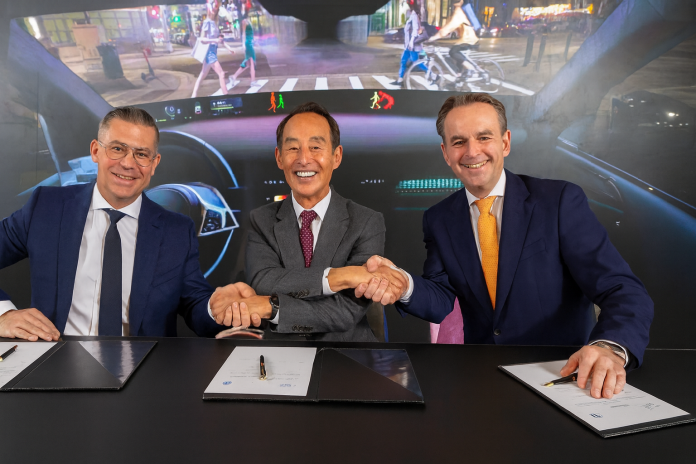
HARMAN International, a wholly owned subsidiary of Samsung, has announced the acquisition of ZF Group’s Advanced Driver Assistance Systems (ADAS) business for €1.5 billion. The deal adds compute platforms, smart cameras, radars, and ADAS software to HARMAN’s portfolio, significantly expanding its role in the evolution of software-defined vehicles (SDVs).
Expected to close in H2 2026, the acquisition deepens HARMAN’s automotive footprint while reinforcing Samsung’s broader mobility and AI ambitions.
Why This Deal Matters
The automotive industry is at an inflection point, where vehicle intelligence, safety, and user experience are converging.
Key forces driving this acquisition include:
- Rapid shift toward centralised vehicle computing architectures
- Growing demand for advanced safety and driver-assist features
- OEM pressure to reduce system complexity while increasing functionality
By acquiring ZF’s ADAS business, HARMAN moves closer to becoming a full-stack automotive technology partner.
ADAS as a Core Pillar of Software-Defined Vehicles
Modern vehicles increasingly rely on centralised compute rather than distributed electronic control units.
ZF’s ADAS assets enable HARMAN to:
- Offer integrated perception, compute, and software stacks
- Support cross-domain integration between safety, infotainment, and connectivity
- Enable scalable architectures for future autonomous features
ADAS becomes not just a safety layer, but a data and intelligence engine.
Leadership Perspective: Unified Architecture as Strategy
Christian Sobottka, CEO and President of HARMAN’s Automotive Division, highlighted the strategic intent:
“Safety, intelligence, and in-cabin experience must come together through a unified computing architecture. This agreement expands our portfolio with complementary ADAS capabilities that unlock a new class of cross-domain experiences.”
The emphasis on unification reflects how OEMs are rethinking vehicle design around platform-level intelligence.
Strategic Implications for OEMs and the Industry
1. Faster SDV Adoption
Integrated stacks reduce complexity and time-to-market.
2. Smarter, Context-Aware Vehicles
Cross-domain data enables richer driving experiences.
3. Increased Platform Consolidation
Suppliers offering end-to-end solutions gain advantage.
HARMAN’s €1.5B acquisition signals a broader industry shift: automotive innovation is becoming a software and systems challenge as much as a mechanical one. As vehicles evolve into intelligent platforms, suppliers that can unify safety, compute, and experience will shape the next decade of mobility.For Samsung and HARMAN, this deal is a decisive step toward owning the intelligence layer of future vehicles.

 business for €1.5 billion.)