Imagine a bustling bazaar. Merchants are shouting prices, buyers are haggling for the best quality goods, and deals are struck with a handshake. Now, imagine that bazaar happening a billion times a second, but instead of people, the deal-makers are sophisticated AI robots.
This isn’t science fiction. It is the new reality of “Agentic Programmatic,” and thanks to a major move by Prebid.org, it’s about to become the industry standard.
For years, “programmatic advertising” has been the engine of the internet. It operates on Real-Time Bidding (RTB) – a rigid, lightning-fast auction system. It’s efficient, but it’s also “dumb.” It follows strict, pre-set rules. A publisher says, “I have this ad slot,” and an advertiser’s computer says, “I bid $1.00.” End of transaction.
But what if the computers could actually talk to each other?
The Big News: Prebid Takes the Wheel
Recently, Prebid.org – the open-source organization that essentially acts as the “governing body” for fair tech standards announced it is taking over the codebase from AdCP (a specialized tech provider).
This is a massive deal. It means the technology to build AI Agents for publishers is moving from a proprietary product into the open-source wild. It creates a standardized playground where everyone can build robots that speak the same language.
From Automation to Autonomy
To understand why this matters, you have to understand the difference between automation and autonomy.
Current programmatic is automation. It’s like a dishwasher; it does exactly what you programmed it to do, every time.
The new Agentic Programmatic is autonomy. Think of it like a smart assistant. You tell it, “Get me the best price for this inventory, but prioritize safe brands.” The AI Agent then goes out and actively works to achieve that goal.
How It Works: The Digital Negotiation
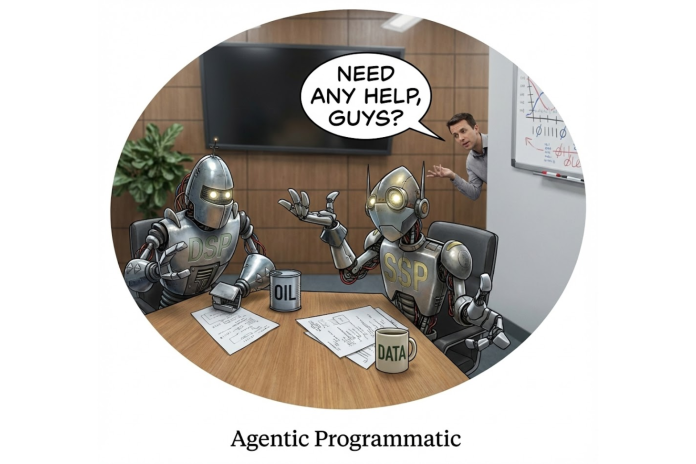
Picture two robots sitting at a conference table (much like the image you envisioned).
- On the left is the SSP Agent (representing the Publisher/Website).
- On the right is the DSP Agent (representing the Advertiser).
In the old world, they just exchanged numbers. in this new world, they negotiate. The SSP Agent might say, “I have a high-value user here, reading a finance article. I want $5.00.” The DSP Agent analyzes its data and replies, “I’ll give you $5.00, but only if you guarantee 100% viewability.” The SSP Agent agrees. Shake hands. Deal signed.
This negotiation happens in milliseconds, powered by Large Language Models (LLMs) that can understand context, intent, and strategy in a way old code never could.
Why Should Publishers Care?
For years, publishers have felt like they are losing control, throwing their inventory into a “black box” and hoping for the best.
With Prebid standardizing this tech, publishers can deploy agents that act as their fiercest sales representatives. These agents work 24/7, never get tired, and can manage millions of micro-negotiations simultaneously. It brings the nuances of a direct sales team to the speed of programmatic.
The Bottom Line
We are witnessing the death of the “dumb pipe” and the birth of the intelligent negotiator. By adopting AdCP’s code, Prebid is ensuring that this AI revolution isn’t locked behind a paywall.
it’s available for the whole open web.
The robots are here to help, and for the first time, they are ready to do some real talking.