
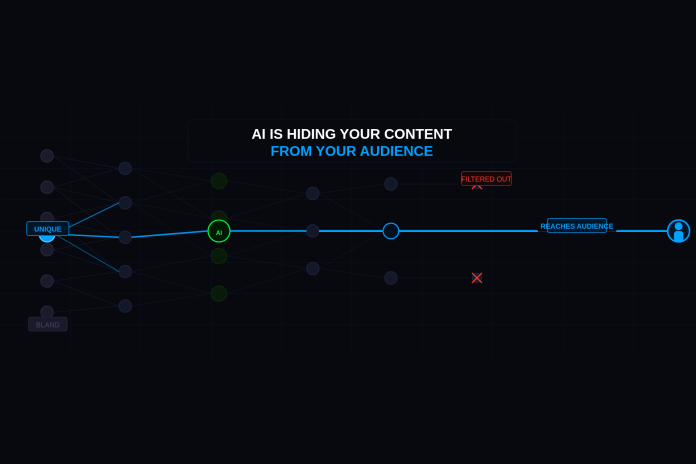
There is a penalty for hitting brands right now that nobody is talking about loudly enough. It does not show up in your analytics as a sudden drop in traffic. There is no algorithm update email, no manual action notice, and no warning of any kind. One day, your content simply stops being recommended. Your brand stops being mentioned. You become invisible, not because you did anything wrong, but because you did nothing interesting.
This is the bland tax. And it is the most expensive bill most marketing teams have ever seen coming.
Where the term came from
Marketing strategist Chris Warden introduced the concept at a session that quietly became the most cited moment in marketing circles this year. His argument was direct and uncomfortable. AI is conditioning itself right now to ignore blandness. Content that feels generic or repetitive simply disappears. If you are generic, you are average. And if you are average or bland, you are invisible.
He was not talking about bad content. Bad content you can fix. He was talking about the enormous volume of technically competent, well-formatted, adequately researched content that fills the internet and says absolutely nothing that has not been said a hundred times before. AI systems do not reward sameness. Instead of highlighting your brand, they summarise similar content into a single answer, often stripping away attribution entirely.
You write the article. AI reads it, absorbs it, learns from it, and then recommends your competitor instead. You contributed to the machine and got nothing back. That is the tax.
How bad the numbers already are
72% of brands actively investing in SEO receive zero citations from AI search engines. That is not a ranking problem. It is a discovery crisis. Nearly three-quarters of the brands spending real money on content and search optimisation are completely absent from the AI answers their potential customers are reading every day.
Organic click-through rates collapsed in 2025, with brands seeing a 61% drop when AI Overviews appeared on their target queries. Zero clicks reached record levels, with 58.5% of U.S. searches ending without any clicks to an external website. The traffic is not going anywhere else. It is simply not leaving the AI answer at all. The user asked a question, got an answer, and moved on. If your brand was not in that answer, the interaction never involved you.
The AI’s top pick becomes the user’s top pick 74% of the time. Only 10% of users chose something ranked third or lower. There is no longer a page 2 where average brands quietly survive. There is a top recommendation, and there is nothing. The bland tax does not demote you. It erases you.
Why does generic content get punished so severely?
When ten brands publish nearly identical articles on the same topic, AI does not rank them all. It synthesises them into a single answer and attributes it to the source with the strongest authority signals. Everyone else disappears without a trace. Without strong authority signals, your brand risks becoming a commodity that is not worth mentioning.
85% of brand mentions in AI answers originate from third-party pages, not from a brand’s own website. This is the part that surprises most marketing teams. The brands winning AI citations are not winning because their blog is good. They are winning because other credible sources on the internet are talking about them, referencing them, and citing them.
44.2% of all LLM citations come from the first 30% of a piece of content, which is the introduction. If your opening paragraph sounds like a template, and most do, AI stops reading before it gets to anything worth surfacing. The bland tax is charged in the first hundred words of everything you publish.
What actually gets through
The data on what AI rewards are now specific enough to act on. Comparison pages with three tables earn 25.7% more citations. Pages built around validation and evidence with eight or more list sections earn up to 26.9% more citations. Pages averaging ten words or fewer per sentence earn 18.8% more citations. Specificity, structure and brevity are the signals that tell AI your content is worth recommending.
The top five consistent drivers of LLM citations are domain authority, high-quality backlinks from DA 60 and above sites, mentions in best and top listicles, total backlink volume, and unique referring domains. None of these is a content quality metric in the traditional sense. They are signals of trust and recognition from the broader internet. Escaping the bland tax is not just about writing better articles. It is about becoming genuinely known as an authority outside of your own website.
The brands escaping the bland tax all share one characteristic. They have a point of view that is specific to them. They publish things only they could publish.
The window is closing
Every day your brand goes uncited is a day your competitors are being recommended in your place. If 30% of your target audience is asking AI for recommendations before they search anything, and you are invisible to AI, you are losing 30% of your potential market share before the race even begins.
Most brands will not feel it until their pipeline starts thinning, and no one can explain why. The content looked fine. The AI just quietly decided they were not worth mentioning, and kept deciding that every single day.
Average content is used to underperform. Now it disappears entirely. The only defence against the bland tax is to stop producing content that sounds like everyone else.